
Trust and control
Autonomy with a hard boundary. Capability tokens, a gateway on a restricted database role, one-shot human approvals, write-only encrypted secrets, and org scoping enforced below the application.
An autonomous agent is only as trustworthy as the worst thing its sandbox can do. UseAgent’s answer is structural: the sandbox is untrusted by design, holds no platform credentials, and everything privileged happens on the trusted side of a boundary it cannot cross.
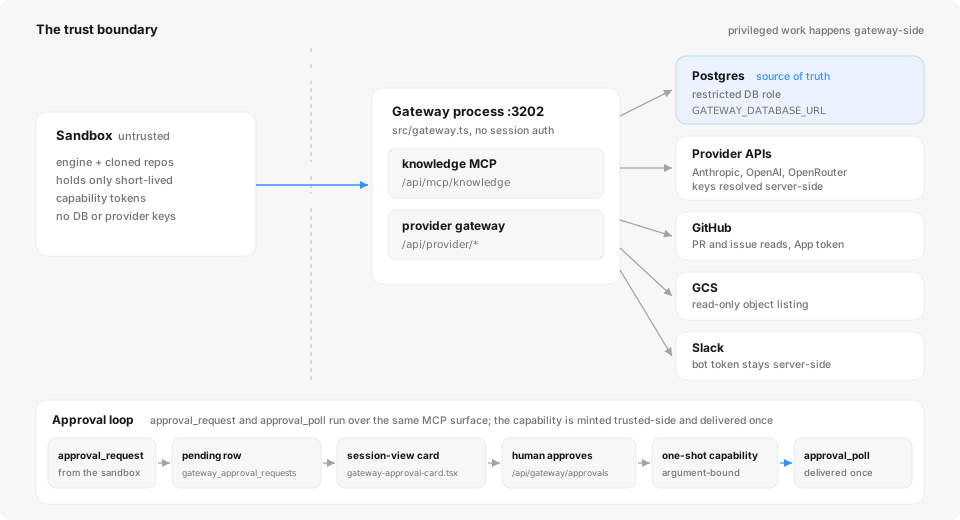
The only surface a sandbox can reach is the gateway. Credentials never cross the boundary; human approval mints one-shot capabilities.
The harness lives outside the sandbox
This is the founding decision. The event log, the workers, org scoping, knowledge, and secrets all live in the backend; the sandbox runs the engine and the work. The UI renders the durable log, never a live process. Everything below follows from it. See Architecture for why the alternatives were rejected.
A gateway, not an open backend
Privileged work (reading a repository, publishing an artifact, using a
provider account) goes through a separate gateway process, not a route in
the product backend (backend/src/gateway.ts):
- It mounts exactly two capability-authenticated surfaces,
/api/mcp/knowledgeand/api/provider, and deliberately has no session auth, no org APIs, no runs, no secrets routes, and no CORS (backend/src/gateway-app.ts). - It can connect to Postgres through a restricted database role with explicit grants and no DDL, so the trust boundary is enforced at the database, not only in application code.
- The role’s grants are reconciled from a manifest in code on every boot, so a migration that adds a gateway-written table ships its grant in the same commit.
Capability tokens, scoped and short-lived
A run cannot mint its own authority. Two signed token families exist:
| Token | What it authorizes | What it binds |
|---|---|---|
| Tool token | MCP tool calls | Organization, user, thread, run, scope, expiry (backend/src/knowledge/gateway/token.ts) |
| Provider token | LLM traffic | All of the above plus the engine and provider (backend/src/provider-gateway/token.ts) |
Scope is run or thread; thread scope exists because a resident engine
session spans queued turns by the same user. Outside a live turn, both
scopes fail closed.
Humans mint the dangerous capabilities
Destructive or outward-facing gated operations pause for a person:
The agent asks
A run calls approval_request for a gated operation.
A card renders in the timeline
The approval card appears in the session view, the only approval surface today.
One transition, exactly once
A pending request moves to approved, denied, or expired exactly once;
every transition is guarded on status = 'pending' in the database.
A one-shot capability is issued
The agent receives a one-shot, argument-bound capability through
approval_poll. It authorizes that operation with those arguments, once,
and can never be self-issued from inside a run.
The lane is live and exercised by the guarded release: a destructive gateway tool pauses for the card and resumes with the capability. The full tool surface and its per-run filtering are covered in Gateway, tools, and approvals.
Secrets are write-only, and injection is visible
Organization secrets follow three rules (backend/src/secrets/):
- Encrypted at rest. Values are sealed with AES-256-GCM under a key
derived by HKDF-SHA256 from operator key material, with a fresh random IV
per seal and a versioned ciphertext envelope that supports key rotation
(
crypto.ts). - Write-only through the API. Metadata is visible; the value is never returned to any client, and provider API keys are resolved inside the signed provider gateway, never handed to a sandbox.
- Injection is intentional and announced. Secrets an organization
configures for the engine’s own tooling are injected into the sandbox
environment, and the timeline shows a names-only
secrets.injectedmarker, so a reviewer can see what was available without ever seeing a value.
The tenant boundary is not client-side
Every resource (runs, skills, knowledge, secrets, integrations) belongs to
exactly one organization, and scoping is enforced by the backend auth layer
and the database, not by the client. Memory adds its own discipline: a run’s
memory scope is server-persisted, never taken from the sandbox or the
prompt at recall time, and a personal-scope run with no authenticated user
fails closed (backend/src/db/schema.ts).
Control means stopping, too
A stop is not a UI gesture; it is a durable run.cancel command through the
same single door as run creation, so a cancel survives the same way the work
does. And when a gated tool declines, the refusal names its remedy: the exact
skill, environment variable, or approval path that would unblock it, so an
agent self-corrects instead of fabricating a result.