
Gateway, tools, and approvals
The trust boundary that does privileged work for a sandbox, the capability tokens that bound it, the in-run tool families, and the human approval lane.
A sandbox is untrusted. Anything privileged, such as reading a repository, publishing an artifact, or using a provider account, happens on the trusted side through the gateway.
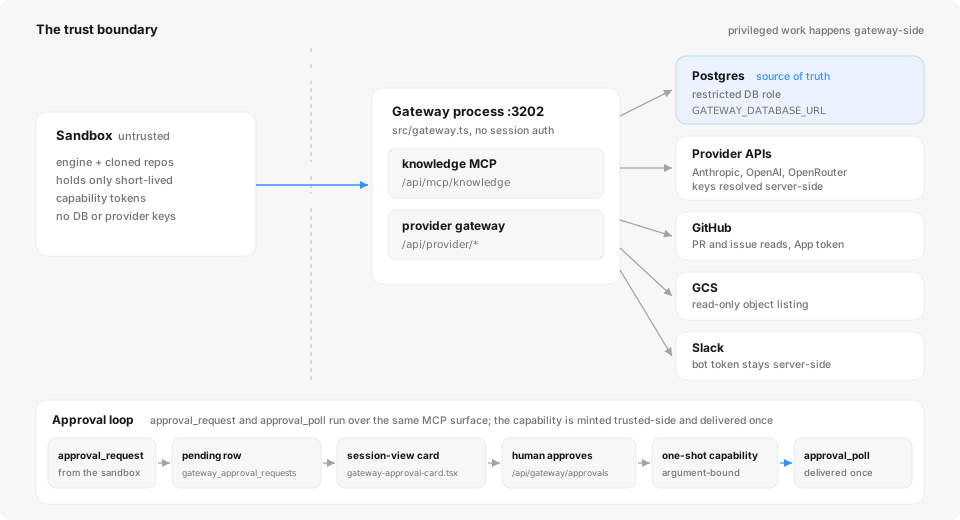
The gateway process () is the only surface a sandbox can reach; credentials never cross the boundary, and human approval mints one-shot capabilities.
Gateway
A backend trust boundary that performs privileged work for a sandbox without placing long-lived provider or database credentials inside it. The sandbox asks; the gateway decides and acts.
Gateway process
The gateway is a separate process, not a route inside the product backend. Its
boot entry (backend/src/gateway.ts) serves a dedicated app on GATEWAY_PORT
(default 3202) and can run under a restricted database role via
GATEWAY_DATABASE_URL. The app deliberately has no session auth, org APIs,
runs, secrets, or CORS; it mounts exactly two capability-authenticated
surfaces, /api/mcp/knowledge and /api/provider
(backend/src/gateway-app.ts). It is the only application that should sit
behind the sandbox-reachable public origin.
Capability token
A short-lived signed grant a run cannot mint for itself. There are two token families:
- Tool tokens authorize MCP tool calls, binding the organization, user,
thread, run, scope, and expiry (
backend/src/knowledge/gateway/token.ts). - Provider tokens authorize LLM traffic and additionally bind the engine
and provider (
backend/src/provider-gateway/token.ts).
Scope is run or thread. Thread scope exists because a resident engine
session spans queued turns by the same user; outside a live turn both scopes
fail closed, and the expiry bound is unchanged.
MCP tool
A typed operation offered to an engine, such as searching knowledge, cloning a repository, controlling the desktop, or publishing an artifact.
Gateway tool families
The full in-run tool surface an engine can call:
| Family | What it does |
|---|---|
| Knowledge | Search organization knowledge, skills, playbooks, and automations. |
| Context | Search and read run context (context_search, context_read). |
| Knowledge drafts | Manage knowledge drafts (knowledge_draft_*); the writes are approval-gated. |
| Memory | Remember and recall scoped facts across sessions. |
| Skills | List and activate versioned procedures by exact id. |
| Automations | Manage scheduled triggers, with an approval capability gating destructive operations. |
| GitHub | Pull-request and issue reads bound to the run’s repository. |
| Repository | List and clone the organization’s repositories (github_repositories, github_clone_repository). |
| Blueprints | List, read, validate, and apply blueprint plans (blueprint_list, blueprint_get, blueprint_validate, blueprint_apply_plan). |
| Child sessions | Create, list, inspect, and gather durable child sessions (child_session_*). |
| Storage | List Google Cloud Storage bucket names (read-only); the service-account credential never leaves the control plane. |
| Web | Web search. |
| Desktop | Computer-use controls with screenshots, plus recording that publishes an MP4 artifact. |
| Login | Guarded ephemeral login. |
| Artifacts | Publish artifacts with absolute links. |
| Workpieces | Create, update, and propose edits to editable workpieces (workpiece_create, workpiece_update, workpiece_propose_edit). |
| Slack | Upload a file to the run’s Slack thread (slack_upload). |
| Gateway meta | Search, describe, and indirectly call gateway tools (gateway_tools_search, gateway_tool_describe, gateway_tool_call). |
Some families are conditional: child-session tools are advertised only when the
run’s engine supports them, and the login and Slack tools only when enabled for
the run. The MCP tools/list response is filtered per live run
(backend/src/knowledge/gateway/operation-registry.ts, mcp.ts).
Provider connection
A user-owned API key or managed account identity, stored by the trusted backend. Metadata is visible to the UI; reusable secrets are write-only and never returned. API keys are resolved inside the signed provider gateway, never handed to a sandbox.
Approval lane
Human-in-the-loop authorization for destructive or outward-facing gated operations:
The agent requests
A run calls approval_request for a gated operation.
A card appears
An approval card renders in the session timeline
(frontend/components/chat/gateway-approval-card.tsx).
A human decides
An org member resolves it in the session view, served by
backend/src/knowledge/gateway/approval-routes.ts. A pending request moves
to approved, denied, or expired exactly once; every transition is guarded on
status = 'pending' (approval-requests.ts).
A one-shot capability is issued
The agent’s approval_poll receives a one-shot, argument-bound capability
exactly once. It can never be self-issued from inside a run.
The approval lane is live and certified by the guarded release: a destructive gated tool pauses for the card, then resumes with the one-shot capability. Slack delivery of approval cards is deliberately deferred; the session timeline is the only approval surface today.