
Architecture
The settled architecture and why each property is load-bearing.
UseAgent’s architecture rests on a short set of settled decisions. Each one is a commitment the rest of the system leans on: verification is evidence-based, state is an event log, engines are replaceable adapters, and every run is an isolated actor.
The four properties
Verify-gated
Verification is an evidence discipline, not self-grading: a conformance suite, environment-gated live proofs, and evidence recorded in the event log. Destructive gateway operations gate on a durable human approval lane with one-shot capabilities. A runtime verify stage on run completion is a design goal, not current behavior.
Event-sourced
The run and step log in Postgres is the source of truth. State is the reduction of an ordered, durable event sequence, so runs replay and survive restarts.
Replaceable-engine
The inner loop is rented behind a neutral adapter. Codex, Claude, and OpenCode are interchangeable at the contract boundary.
Actors
Each thread is an isolated actor with its own sandbox and working directory, held on a per-thread lease. Each run is one turn inside it, driven from outside by the harness.
The harness lives outside the sandbox
This is the decision everything else follows from. The backend is the harness: the event log, the workers, the SSE fan-out, org scoping, and knowledge all live on the trusted side. The sandbox runs the engine and the work. The UI renders the log, never a live process.
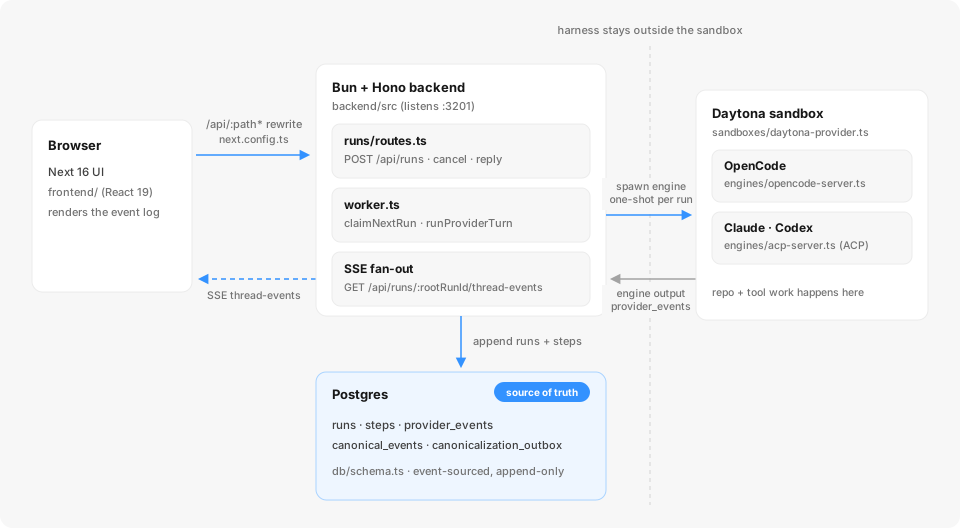
One turn end to end: the harness (routes, worker, SSE fan-out, Postgres) stays on the trusted side of the dashed line; only the engine and its work run inside the Daytona sandbox.
The consequences are concrete:
- A run survives a backend restart, because its truth is the log, not a process’ memory.
- Three different engines render through one UI contract, because their native output is durably stored first, then translated into one provider-neutral canonical schema by a post-finalize outbox worker, and canonical events are persisted before they are published to subscribers.
- A sandbox holds no platform credentials: privileged work goes through the
gateway, reached only with a
short-lived signed run token. Org-configured secrets are intentionally
injected for the engine’s own tooling and surfaced in the timeline as a
names-only
secrets.injectedmarker.
Where to go next
- Request flow traces one turn from prompt to rendered timeline.
- Realtime and canonicalization covers the streams and the single-backend constraint.
- Shared packages are the contracts that keep the frontend and backend honest.