
Engines
The inner loop is rented, not built. Codex, Claude, and OpenCode behind one neutral adapter boundary, capability-gated surfaces, and a subscription relay that keeps OAuth out of the sandbox.
The fastest-moving part of the agent stack is the inner loop: the model-driven process that decides what to do next. UseAgent deliberately does not compete with it. Engines are rented: Codex, Claude, and OpenCode each run behind a neutral adapter, while UseAgent owns what compounds: orchestration, history, approvals, knowledge, and rendering.
One boundary, three engines
An adapter (backend/src/engines/) translates between an engine’s native
protocol and UseAgent’s thread, command, and event contracts. Above the
adapter, nothing branches on a vendor:
- The timeline renders canonical events, never a provider’s private schema.
- Surfaces are gated on the session’s negotiated capability map, never on
engine === "..."checks. An engine without plans or reasoning simply never lights those surfaces up. - Provenance stays honest: every event retains the engine’s native ids in its identity, and the raw native frames are kept as a bounded sidecar for debugging.
The base engine set ships enabled, and the ENABLED_ENGINES environment list
can only add engines on top of it, never disable the base
(backend/src/env.ts). The composer’s engine picker reflects exactly the
enabled set.
Two adapter routes
Runtime path
The primary orchestration route (backend/src/engines/runtime-*),
carrying authoritative history, approvals, questions, child agents,
patches, todos, reasoning, and usage. Operator-gated by
RUNTIME_RUN_ADAPTER_ENABLED with a canary or all mode.
ACP compatibility
The Agent Client Protocol route for the resident Claude and Codex lane when the runtime path is not selected, with fewer authoritative lifecycle surfaces.
Engine processes are resident per thread sandbox and reused across turns: a
persistent opencode serve for OpenCode, and a resident ACP relay whose
session is reloaded turn to turn, with a generation counter that stops a
stale pre-restart session from being replayed against a newer process. The
settled invariants are narrow and firm: no engine UI servers or iframes, and
no engine process outliving its thread’s sandbox.
The subscription relay
Driving a managed ChatGPT subscription normally means putting OAuth state where the code runs. UseAgent refuses:
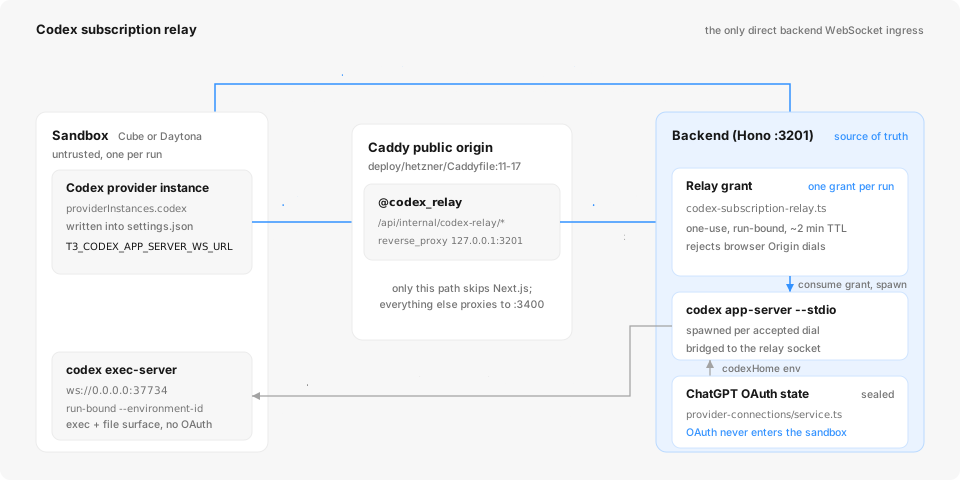
One grant per run: a one-use, run-bound WebSocket capability lets the sandbox reach a backend-hosted app-server, so the subscription drives the run while OAuth never crosses the boundary.
The relay is proven end to end in production: first turns, multi-turn replies that continue a bound thread across driver restarts, and the run-bound tool surface.
Readiness is credential-mode aware
A release proves the path that matches how an engine actually authenticates:
a subscription-only Codex release proves the connected account and the native
turn path, while an API-key engine proves its mapped gateway provider
(backend/src/runs/engine-readiness.ts). Model choice follows the same
honesty: the per-turn model picker appears only for engines whose capability
map advertises modelSelection.
Why renting wins
Engine quality improves monthly, and adapter code is small compared to a harness. Because every engine lands in the same contract with the same delivery guarantees, adopting a better engine is an adapter task, not a product rewrite. A thread stays on the engine it started with (a reply with a different engine is rejected explicitly rather than silently rebound), while the model can change turn to turn where the engine allows it. The full mechanics live in Engines and adapters.