
The agent contract
The canonical spec. One provider-neutral event grammar, a versioned envelope, a negotiated capability map, and the delivery guarantees every engine must satisfy.
Most agent products are married to one engine’s private event schema. UseAgent is built the other way around: there is one canonical wire grammar, and every engine is translated into it. The UI, the replay path, and the API all consume this contract and nothing else. Swap the engine and nothing above the adapter changes.
This page is the spec. The source of truth is a single pure-types module,
packages/agent-harness/src/canonical.ts, deliberately free of provider SDKs,
sandbox code, and behavior.
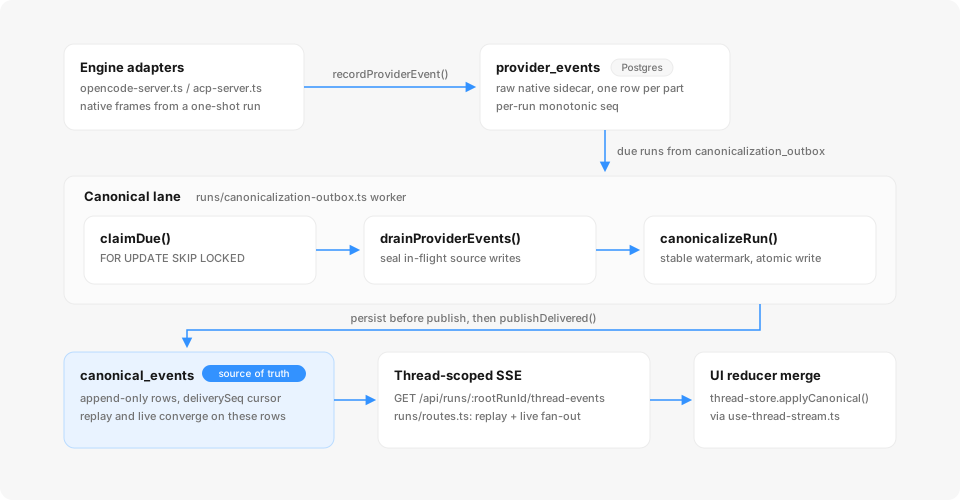
The contract in motion: native engine output is durably stored, sealed, and translated into canonical events, which are persisted before any subscriber sees them.
The envelope
Every canonical event carries the same base envelope (CanonicalEventBase):
| Field | Meaning |
|---|---|
schemaVersion |
The contract version. Currently 1; bumped only with a migration, and readers must tolerate older rows. |
eventId |
Stable per (run, native event), so a re-emitted event is an idempotent revision, not a duplicate. |
seq |
UseAgent’s own monotonic cursor within the run’s source order. |
runId, threadId, turnId |
Where the event belongs in the run, thread, turn hierarchy. |
ts |
Assigned or validated by the backend. A provider’s clock is never trusted. |
identity |
Provenance: the provider tag plus the native session, event, message, and part ids. |
Provenance is first-class. CanonicalIdentity keeps the engine’s native ids
(an OpenCode ses_*/msg_*/prt_*, an ACP session id) alongside the neutral
shape, so a raw trace can always be correlated without the UI understanding any
provider’s private schema. The ProviderId is an open string, not an enum: a
future harness adds a string, and no code here changes.
The event vocabulary
The contract is a discriminated union of 30 event kinds, grouped by the surface they drive:
| Group | Kinds |
|---|---|
| Session and turns | session.started, session.metadata, turn.started, turn.completed |
| Messages | message.started, message.delta, message.completed |
| Reasoning | reasoning.delta, reasoning.completed |
| Plans | plan.updated |
| Tools | tool.started, tool.progress, tool.completed |
| Files and artifacts | file.changed, artifact.created, artifact.delivered |
| Terminal | terminal.output |
| Child sessions | child.started, child.updated, child.completed |
| Approvals | approval.requested, approval.resolved |
| Questions | question.requested, question.resolved |
| Commands and mode | commands.updated, mode.updated |
| Usage | usage.updated |
| Context markers | context.marker (memory, knowledge, skill, playbook, rule, reconciling) |
| Harness diagnostics | harness.warning, harness.error (with a fatal flag) |
Three design rules keep the union honest:
- Exhaustiveness is compile-checked. Switches over
kindend inassertNeverEvent, so an unhandled kind is a build error, not a silent drop. - Optional surfaces never fake it. A harness without reasoning or plans simply never emits those kinds, and the UI shows the surface only when real events arrive.
- Large payloads stay out of band. Tool output, diffs, and files travel as
an
ArtifactRef(id, bytes, sha256, content type); the timeline keeps a bounded preview and fetches the full artifact lazily.
Negotiated capabilities
Engines differ, and the contract refuses to paper over that with provider
checks. At session start, a capability map (NegotiatedCapabilities) of 20
boolean flags is negotiated (ACP negotiates; other harnesses report a static
manifest) and persisted with the session:
| Area | Flags |
|---|---|
| Streaming and structure | streamingText, reasoning, plans, toolProgress, fileDiffs |
| Delegation | childSessions |
| Interaction | approvals, questions, commands |
| Accounting and choice | usage, modelSelection |
| Session lifecycle | resume, load, close, stop, reconcile |
| Runtime surfaces | directTerminal, desktop, nativeEmbed, knowledgeTools |
The UI gates every surface on this map and never on an engine name. A missing
or non-boolean flag normalizes to false
(normalizeNegotiatedCapabilities), so an absent capability reads as an
honestly omitted surface rather than a broken one. The model picker, for
example, appears only when modelSelection is true, which is why it shows for
OpenCode sessions and hides for fixed-model ACP engines.
Delivery guarantees
A grammar is only as good as its delivery. The canonical lane
(backend/src/runs/canonical-events.ts) enforces four invariants:
Persist before publish
An event is written to the canonical_events table and only then emitted to live subscribers, so a reconnect replays exactly the rows a live viewer saw.
Immutable delivery cursor
deliverySeq only increases, thread-wide, and is never mutated or reordered. The browser resumes with “everything after N”.
Append-only revisions
A re-emitted eventId inserts a new row with a higher revision; consumers keep the latest revision per eventId. History is never rewritten in place.
Thread-scoped channel
Publish and subscribe are per thread, not per run, so one subscription covers every run in a conversation, including runs created later.
The completion discipline
Translation is driven by a durable outbox
(backend/src/runs/canonicalization-outbox.ts) with a strict
never-trust-provisional rule:
- The intent commits with the run. Finalizing a run enqueues its canonicalization inside the same transaction, so a crash can never leave a settled run with no canonical history.
- The source is sealed first.
drainProviderEventscloses the native frame lane before translation, so a late write cannot slip under the translator. - Completion is watermark-proven. The worker re-reads the source
watermark after translating: the max native frame sequence plus a content
signature over every step. It marks the run
completeonly if both held steady, which catches even an in-place step rewrite that a row count would miss. - Clients trust only the completion signal. Until the durable canonicalization-complete record exists, provisional rows are replaceable working state, and no reader treats them as truth.
Durable sessions and commands
The contract extends past events to the state around them:
- Sessions are rows, not process memory.
HarnessSessionpersists the provider, native session id, runtime binding, protocol version, capability map, and agenerationcounter that stops a stale pre-restart session id from being replayed against a newer engine process. - Commands are part of the grammar. A provider’s slash-command catalog is
captured as a durable provider event (
acp.commands) and replayed ascommands.updated, sealed by the same drain barrier as every other frame. - The run lifecycle is small on purpose. A run is
queued,running,completed, orfailed, and exactly two durable command kinds exist:run.create(a reply is arun.createcarryingparent_run_id) andrun.cancel. See Runs, threads, and commands.
Why this is the flagship
Every other feature stands on this contract. Replaceable engines are possible because adapters target one grammar. Reliability is possible because the grammar is persisted before it is shown. The product experience can be polished once and inherited by every engine because the timeline reads kinds and capabilities, never vendors. The native frames are still retained as a bounded raw sidecar for fidelity and debugging, but nothing in the product branches on them.
For the transport details, continue to Events and streaming and Realtime and canonicalization.