---
title: Reliability
description: Work that survives. Runs outlive backend restarts, reconnects replay exactly what live viewers saw, retries are idempotent, and releases pass real engine journeys before they ship.
sidebar:
  order: 4
---

An agent run is minutes of real work: clones, edits, builds, browser sessions.
Losing it to a crashed process, a dropped connection, or a double-clicked
submit is not acceptable. UseAgent treats reliability as an architectural
property, not an ops aspiration: **the truth of a run is a durable event log,
and everything else can die and come back.**

## One durable door in

Every channel (the web app, Slack, scheduled automations) enters through the
same `acceptRunCommand` lane, which records a durable command before any work
starts (`backend/src/commands/`). That single door carries the retry
semantics:

- A command **may carry a per-organization idempotency key**. A retried
  submission observes the original command instead of starting duplicate
  work, and a reused key with a different payload fingerprint is rejected
  with a 409 rather than silently rerun.
- Dispatch is **serial per thread**: at most one command per thread is in
  flight at a time, so replies and child sessions queue instead of racing one
  sandbox (`backend/src/commands/dispatch.ts`).

## Runs survive backend restarts

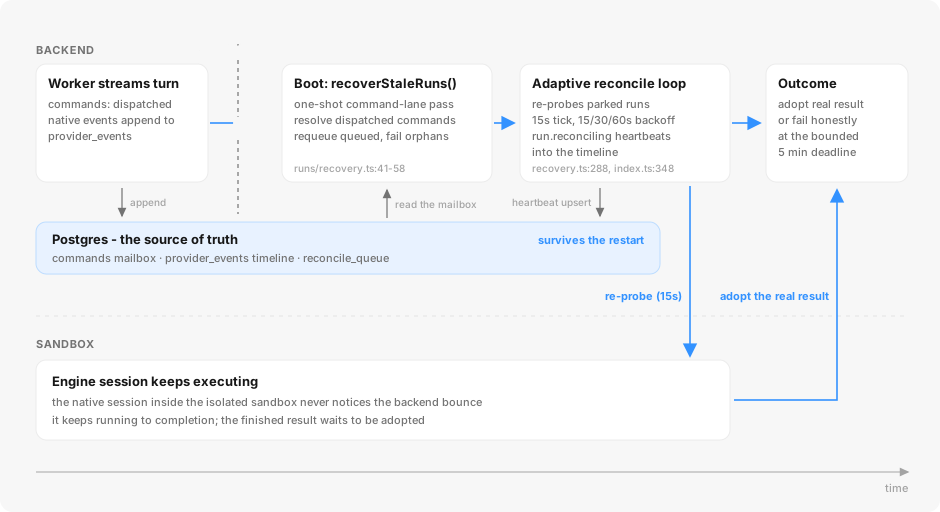
The sandbox executes independently of the backend, so a backend bounce does
not kill a live run.

<div style={{ background: "#ffffff", border: "1px solid #ebebeb", borderRadius: "12px", padding: "16px", margin: "1.5rem 0" }}>
  <img
    src="/docs/diagrams/run-survives-backend-restart.svg"
    alt="Two lanes over time: the sandbox keeps executing through a backend crash while boot recovery and the adaptive reconcile loop adopt the finished result"
    style={{ width: "100%", height: "auto", display: "block" }}
  />
  <p style={{ margin: "12px 4px 0", fontSize: "13px", color: "#737373" }}>
    The sandbox lane never stops: a one-shot boot pass settles the commands
    mailbox, then an adaptive loop re-probes the live session with visible
    reconciling heartbeats until it adopts the real result or fails honestly
    at a bounded deadline (backend/src/runs/recovery.ts).
  </p>
</div>

The recovered run **adopts the finished result** rather than discarding work
that actually completed, and failure at the deadline is an explicit, classified
outcome, not a hang.

## Reconnects are replays, not guesses

Because the canonical lane persists every event before publishing it and
stamps it with an immutable thread-wide delivery cursor, a browser reconnect
resumes with "everything after N" and receives **exactly the rows a live
subscriber saw** (`backend/src/runs/canonical-events.ts`). The thread-scoped
stream hands back a durable snapshot first, then live events, so a flaky
network produces a clean resync instead of a flash of empty or duplicated
timeline. Details in [Events and streaming](/concepts/events-and-streaming).

Finalization carries the same discipline: a run's canonicalization intent is
enqueued **inside the finalization transaction**, and the outbox worker marks
it complete only when a re-read source watermark proves nothing arrived
mid-translate (`backend/src/runs/canonicalization-outbox.ts`). A crash can
interrupt the worker at any point and the retry converges on the same result.

## Boot order is load-bearing

The backend boots in a fixed order: **advisory lock, migrations, gateway
grants, seed, stale-run recovery** (see [Operational
invariants](/operations/invariants)):

- A per-database Postgres advisory lock guarantees one backend per database,
  and production sets `REQUIRE_SINGLE_BACKEND=true` so a duplicate refuses to
  boot. This is honest engineering: the provider-source seal and the SSE
  fan-out are process-local today, so multi-replica realtime is explicitly
  unsupported until a durable seal lands.
- Migrations apply at every boot, stamped strictly above the journal tail, so
  ordering mistakes fail loudly instead of skipping silently.
- Only after locks, migrations, and grants does the backend recover stale
  runs left by an unclean shutdown.

## Proof before ship

Reliability claims are tested at two altitudes
([Verification](/operations/verification)):

<CardGroup cols={2}>
  <Card title="Deterministic suites" icon="flask-conical">
    Backend tests against an isolated throwaway database, frontend and shared
    package suites, and a root typecheck. Fast and safe anywhere.
  </Card>
  <Card title="Storm and journey suites" icon="cloud-lightning">
    A mock full-stack pass including crash-survival stages, real-sandbox end
    to end journeys, storm coverage over the durable lanes, and a browser
    sweep of rendered surfaces.
  </Card>
</CardGroup>

Before a release candidate ships, the guarded lane runs a **22-case parity
matrix of real engine journeys** (repository clone, desktop and recording,
artifact publish, thread resume, model switch, subagent fanout, workpieces,
memory, and more) against the candidate, then re-runs the hard journeys
through the authenticated public APIs after atomic activation. A candidate
that fails does not ship, and the lane rolls back. Releases are built from an
**immutable checkout** of the committed HEAD, verified by tree hash; a dirty
working tree refuses to deploy.

:::note
**What is not claimed.** There is no sandbox pause, checkpoint, or snapshot
resume; recovery re-probes and adopts. Multi-replica backends against one
database are unsupported by design until the seal and fan-out are durable.
The reliability story is strong precisely because its edges are stated.
:::
